
How to Maximise Annual Leave UK 2026
The complete guide to turning 28 days of UK annual leave into 72 or more consecutive days off in 2026 — by targeting the right bank holiday stretches.
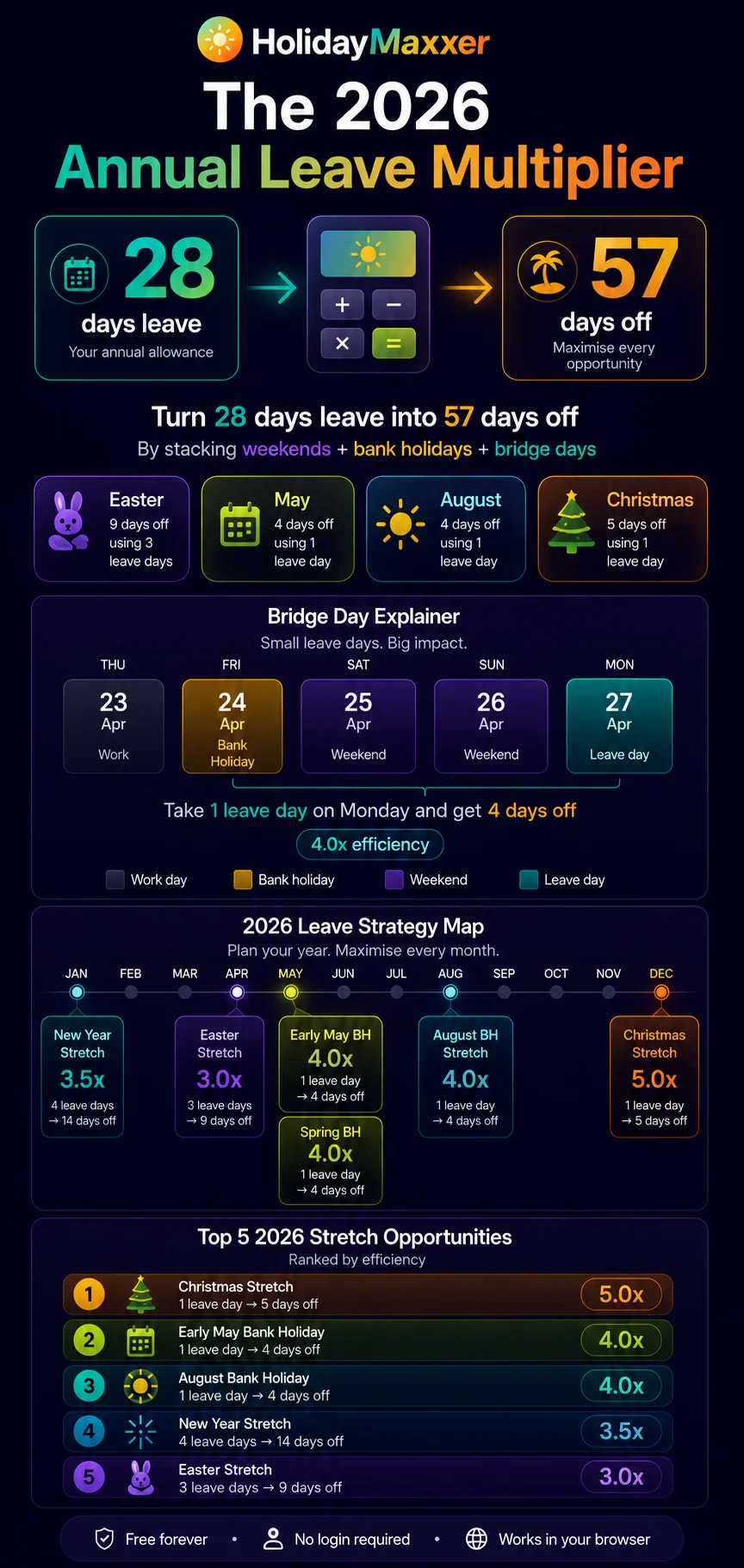
If you are one of the millions of UK workers who gets 28 days of annual leave per year and spends most of it on random long weekends and last-minute bookings, this guide is for you. In 2026, the UK bank holiday calendar falls in a way that makes it possible to get 72 or more consecutive days off using your standard 28-day allowance — if you know which dates to target.
This is not a trick. It is simple arithmetic. Weekends and bank holidays are already free. Your leave days only need to fill the gaps between them. When a bank holiday falls on a Thursday and Friday, booking the Monday, Tuesday and Wednesday before it gives you nine consecutive days off for just three leave days. Multiply that logic across the whole year and your 28 days of leave can produce far more than 28 days off.
How the UK annual leave system works
Every worker in the UK is entitled to a minimum of 28 days of statutory annual leave per year (20 days plus eight bank holidays, or 28 days inclusive of bank holidays depending on your contract). For most salaried workers on a standard contract, bank holidays are given on top of annual leave, meaning you have eight free days already built into your year before you book a single day.
Those eight bank holidays are:
- New Year's Day — Thursday 1 January 2026
- Good Friday — Friday 3 April 2026
- Easter Monday — Monday 6 April 2026 (England & Wales only)
- Early May Bank Holiday — Monday 4 May 2026
- Spring Bank Holiday — Monday 25 May 2026
- Summer Bank Holiday — Monday 31 August 2026
- Christmas Day — Friday 25 December 2026
- Boxing Day — Saturday 26 December (substitute Monday 28 December 2026)
Each of these is an anchor point. The leave days you book around them — not instead of them — are what create your stretches.
The core strategy: bridge days
A bridge day is a leave day that connects a bank holiday to a weekend, or one bank holiday to another. Bridge days are where the multiplication happens.
Example — Easter 2026
Good Friday (3 April) and Easter Monday (6 April) are both bank holidays. The weekend of 4–5 April is already free. If you book Wednesday 1 April, Thursday 2 April and Tuesday 7 April as leave, you get 7 consecutive days off using just 3 leave days — a 2.3× ratio. Add Monday 30 March as a fourth leave day and you extend to 9 consecutive days off.
Example — Christmas 2026
Christmas Day falls on Friday 25 December. Boxing Day falls on Saturday 26 December, with the substitute bank holiday on Monday 28 December. If you book Tuesday 29 December as leave: Friday 25 → Tuesday 29 gives you 5 days off for 1 leave day. A 5.0× efficiency ratio — the best single-day value available in 2026.
The best stretch opportunities in England & Wales 2026
1. Christmas / New Year stretch — 5.0× efficiency
Use 1 leave day (Tuesday 29 December) to extend Christmas bank holidays into a 5-day break. Add Wednesday 30 and Thursday 31 December for 2 more leave days and combine with New Year's Day to get 8 consecutive days off using just 3 leave days.
2. Easter stretch — up to 3.0× efficiency
Use 3 leave days around Good Friday and Easter Monday to get 9 consecutive days off. The most popular stretch of the year.
3. May bank holidays — 4.0× on individual days
The Early May bank holiday (Monday 4 May) and Spring bank holiday (Monday 25 May) both create four-day weekends. Book the Tuesday after either one for a single leave day that adds a fifth consecutive day off.
4. New Year 2026 — 4.0× efficiency
New Year's Day falls on Thursday 1 January. Bookending it with Monday 29 December, Tuesday 30 December, Wednesday 31 December (leave) and Friday 2 January (leave) produces 7 days off for 4 leave days.
5. August bank holiday — 4.0× efficiency
Summer bank holiday is Monday 31 August. Book Tuesday 1 September for 1 leave day and get a 5-day break.
Tips for getting leave approved
Book early. Most HR policies operate on a first-come, first-served basis. Submit your Easter and Christmas leave requests in January.
Stagger with colleagues. If your team all want the same Easter week off, propose a rotation — you take Easter, they take the May bank holiday week.
Frame it professionally. Instead of "I want time off," say "I'd like to take leave from [date] to [date] — I'll ensure [project/handover] is completed before I go."
Check your contract. Some contracts require a minimum notice period (often twice the length of the leave requested). A 9-day Easter break may require 18 days notice minimum.
Calculate your personal plan
Enter your leave allowance below — the calculator finds every stretch automatically and ranks them by efficiency.
0 of 28 used
Non-working days act as free bridge days. PTO is only auto-spent on your selected working days.
Or tap days on the calendar to mark your own leave.
- Bank holiday
- Weekend
- Your leave
- WFH day
- Suggested
- Stretch
Currently planning England & Wales 2026.
Thursday 1 January 2026